ADA Parking Lot Striping & Compliance in Tampa Bay
Radiant Striping stripes commercial parking lots to the 2010 ADA Standards for Accessible Design and Florida's accessibility law, Section 553.5041 of the Florida Statutes. That covers accessible space counts, van spaces, five-foot access aisles, blue outlines, FDOT-approved signage, and slope. We bring the striping, signage, and space layout to spec on lots across nine Florida counties, backed by 244 five-star Google reviews. And if your lot is being restriped anyway, DOJ guidance says that is the moment it must meet the current standards.
Updated July 2026
We Make Parking Lots Better
See the work up close.
Fresh mascot stencils. ADA accessible spaces to the 2010 ADA Standards. Crisp fire lane curbing and full parking layouts across Tampa Bay. Backed by 244 five star Google reviews.
That video is our radio commercial. Here it is word for word:
Radiant Striping, Radiant Striping. Brighter and bolder, neatly measured. Radiant Striping, Radiant Striping. We make parking lots better. From faded stripes to good as new, Radiant Striping comes through for you. Radiant Striping, Radiant Striping. We make parking lots better. Get your quote today at RadiantStriping.com.
“He gets the MOSI seal of approval.”
John Graydon Smith, President & CEO, MOSI
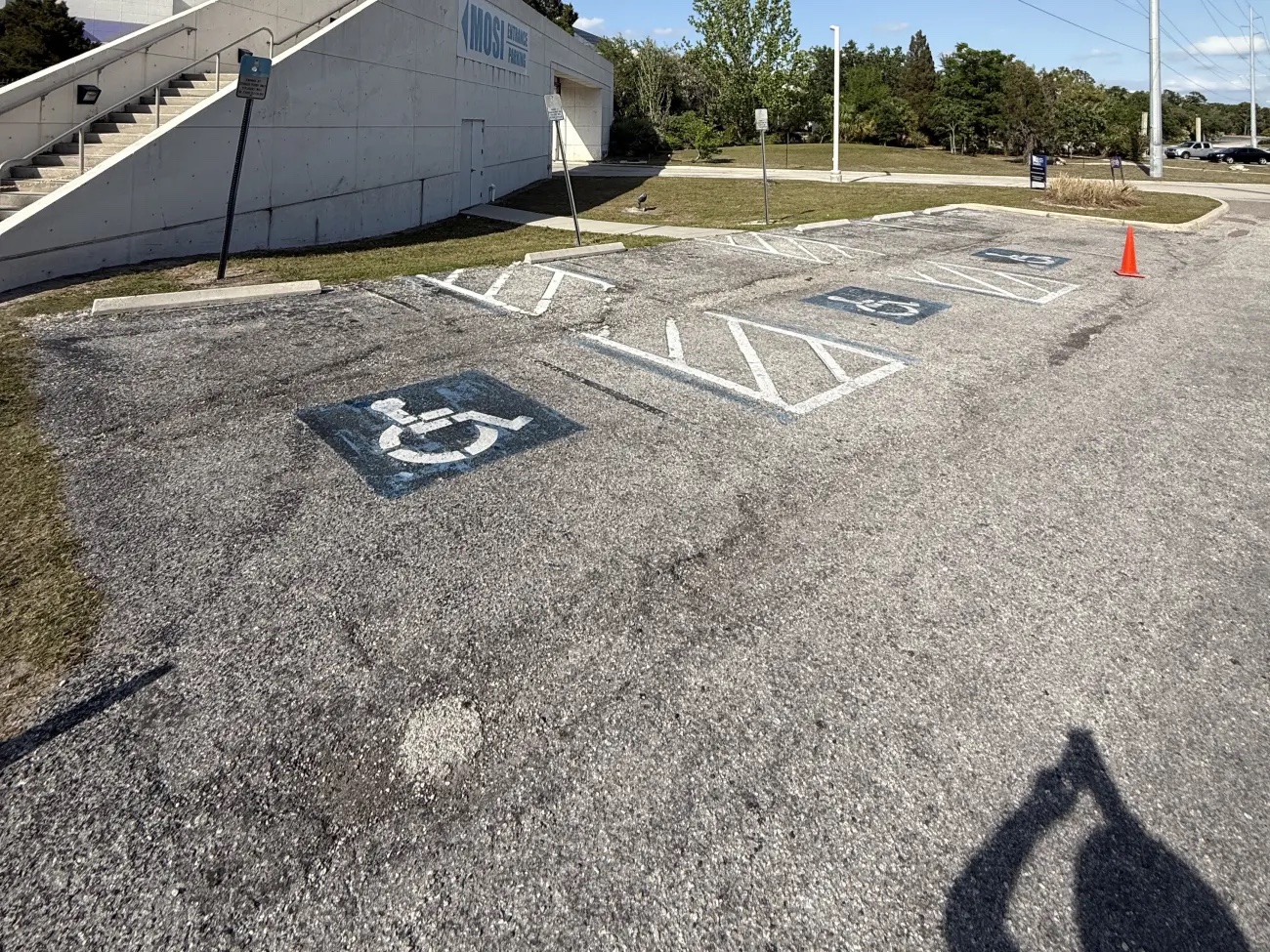
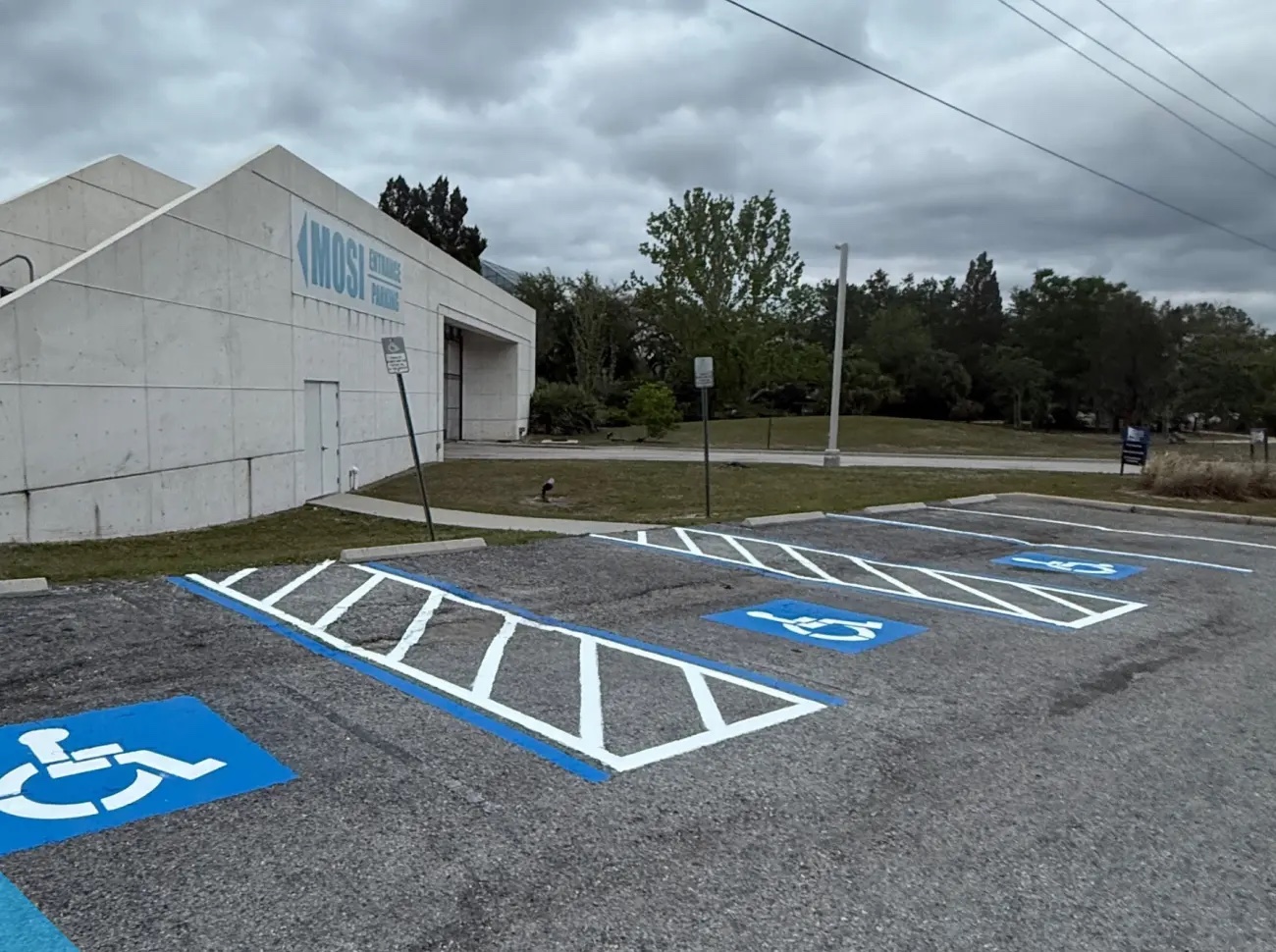
Radiant Striping patched and restriped the parking lot at Tampa's Museum of Science and Industry, working into the night after the museum closed for the day. The before and after below is the ADA parking out front, one part of the lot.
How Many Accessible Spaces Your Lot Needs
Radiant Striping sizes every Tampa Bay lot from Table 208.2 of the 2010 ADA Standards: the total number of spaces in the lot sets the required accessible count. Count each parking facility separately, not the site as a whole.
| Total spaces in the lot | Required accessible spaces | Of those, van accessible (1 of every 6) |
|---|---|---|
| 1 to 25 | 1 | 1 |
| 26 to 50 | 2 | 1 |
| 51 to 75 | 3 | 1 |
| 76 to 100 | 4 | 1 |
| 101 to 150 | 5 | 1 |
| 151 to 200 | 6 | 1 |
| 201 to 300 | 7 | 2 |
| 301 to 400 | 8 | 2 |
| 401 to 500 | 9 | 2 |
| 501 to 1,000 | 2 percent of total | 1 of every 6 |
| 1,001 and over | 20, plus 1 for each 100, or fraction of 100, over 1,000 | 1 of every 6 |
At least one of every six accessible spaces, or any fraction of six, must be van accessible. Medical properties run higher: 10 percent of patient and visitor parking at hospital outpatient facilities, and 20 percent at rehabilitation facilities that treat mobility conditions and at outpatient physical therapy facilities. Accessible spaces go on the shortest accessible route to the entrance, dispersed when there is more than one entrance.
What an Accessible Space Must Look Like in Florida
Twelve feet wide with a five-foot access aisle. That is the Florida spec under Section 553.5041 of the Florida Statutes, and it is stricter than the federal minimums of 96 inches for a car space and 132 inches for a van.
The access aisle gets diagonal stripes marking it as a no-parking zone. It runs the full length of the space, connects to an accessible route, and never overlaps the drive lane. Two spaces may share one aisle.
The space itself is prominently outlined in blue and repainted when it fades. Surfaces stay nearly flat: no more than a 1:48 slope in any direction, with the aisle at the same level as the space.
Van-accessible spaces also need 98 inches of vertical clearance and their own sign designation. Radiant Striping paints every accessible space on a Tampa Bay commercial lot to the 12-foot Florida standard.
Signage: The Part Most Lots Get Wrong
Paint alone does not make an accessible space enforceable in Florida. Each space needs a permanent above-grade sign of a color and design approved by the Florida Department of Transportation, mounted so the bottom of the sign sits at least 60 inches above the ground, carrying the International Symbol of Accessibility and the caption PARKING BY DISABLED PERMIT ONLY. Signs installed after October 1, 1996 must state the penalty.
Here is the part property managers miss, from Section 316.1955 of the Florida Statutes: with no above-grade sign, an officer can only issue a warning, not a fine. An unsigned space carries no real penalty.
Blocking the access aisle draws the same fine as parking in the space: $100 under Section 318.18(6) of the Florida Statutes, or the amount your county sets by ordinance, plus court costs. One exception on signage: lots with four or fewer total spaces do not require the sign. Radiant Striping installs FDOT-approved signs with the striping on Tampa Bay lots, so the spaces it paints carry real penalties.
Restriping Triggers Compliance
A restripe is the moment your lot must meet the current standards. Department of Justice guidance puts it plainly: when a business restripes its parking lot, it must provide accessible parking spaces as required by the 2010 ADA Standards.
The obligation does not stop there. Businesses have a continuing duty to remove access barriers where it is readily achievable, and the DOJ notes that because restriping is relatively inexpensive, it is readily achievable in most cases.
Sealcoating ends at the same trigger, because every sealcoat is followed by a full restripe. Radiant Striping checks the count, dimensions, aisles, slope, and signage against the standards on every striping and sealcoating quote in Tampa Bay, so the compliance question is answered before the paint goes down. Radiant Striping handles both parking lot striping and sealcoating on Tampa Bay commercial lots.
Failed an Inspection or Received an ADA Demand Letter?
Radiant Striping brings Tampa Bay lots back to spec fast when a demand letter, inspection report, or tenant complaint lands. The typical complaint cites visible problems: a missing van aisle, faded markings, the wrong space count, absent signs.
The owner walks your lot, checks it against the 2010 ADA Standards and Florida law, and gives you a written scope of exactly what is out of spec. Then the crew stripes the spaces, marks the aisles, and installs the signs, and you get photos of the finished work for your records. If the problem is the asphalt itself, a slope or grade issue paint cannot fix, you get told that too, along with what fixing it takes. That is The Right Fix: the lot gets what it needs, nothing more.
Frequently Asked Questions
How many accessible spaces does a 50-space parking lot need?
Two, under Table 208.2 of the 2010 ADA Standards, and one of the two must be van accessible. Radiant Striping runs this count on every Tampa Bay lot it stripes.
How wide is an ADA parking space in Florida?
At least 12 feet, with a five-foot access aisle, under Section 553.5041 of the Florida Statutes. The federal minimum elsewhere is 96 inches for a car space and 132 inches for a van. Radiant Striping stripes Florida lots to the stricter 12-foot rule.
What color are handicap parking spaces in Florida?
Blue. Florida law requires each accessible space to be prominently outlined in blue paint, with the access aisle striped diagonally as a no-parking zone. Radiant Striping repaints faded Tampa Bay spaces to that spec.
Does restriping a parking lot require ADA compliance?
Yes. Department of Justice guidance says a business that restripes its lot must provide accessible parking spaces per the 2010 ADA Standards. The restripe itself is the trigger.
What is the fine for parking in a handicap space in Florida?
$100 under Section 318.18(6) of the Florida Statutes, or the amount your county sets by ordinance, plus court costs. Blocking the access aisle draws the same penalty. The FDOT-approved signs Radiant Striping installs carry the required penalty language.
Do accessible spaces need signs, or is paint enough?
Paint is not enough. Each space needs a permanent FDOT-approved sign mounted at least 60 inches to its bottom edge. Under Section 316.1955, no above-grade sign means officers can only issue warnings, not fines. Radiant Striping installs the sign with the stripe. The main exception for commercial lots is four or fewer total spaces.
Bring Your Lot to ADA Spec
Radiant Striping brings the striping, signage, and space layout on commercial lots to ADA spec across all nine Florida counties: Hillsborough, Pinellas, Pasco, Polk, Hernando, Citrus, Manatee, Orange, and Sarasota. One accountable owner. Call (813) 448-1252 or request a free quote.
244 five star Google reviews. The safest bet in Tampa Bay.
This page summarizes federal and Florida accessibility requirements for commercial parking lots, verified against ADA.gov and the Florida Statutes. Updated July 2026. It is general information for property owners and managers, not legal advice. Confirm requirements for your specific property with your local code official or attorney.